
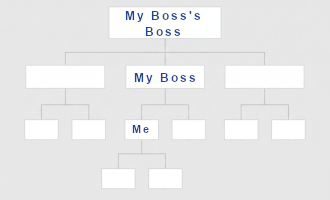
 One way to figure out what works and what doesn’t is to look back at your own history – the people you’ve worked with or for, and rate them on their leadership skills. One of the problems with this approach is that everyone has their own measurement scale or yardstick. I’ve tried to step outside that a bit and look at people’s skills and not so much whether I liked them, or they liked me.
I’ve had the luxury of working in several large and small organizations in a variety of roles. With that, I’ve had the experience or working with 21 bosses. I like to think I’ve learned from some of the greatest as well as some not-so-great.
Here’s what I came up with. Rating them on a scale from 1 to 10 (with 10 being highest). I worked for my dad from age 13 to 18 but I’ll leave him out of this… that is absolutely a story for another day.
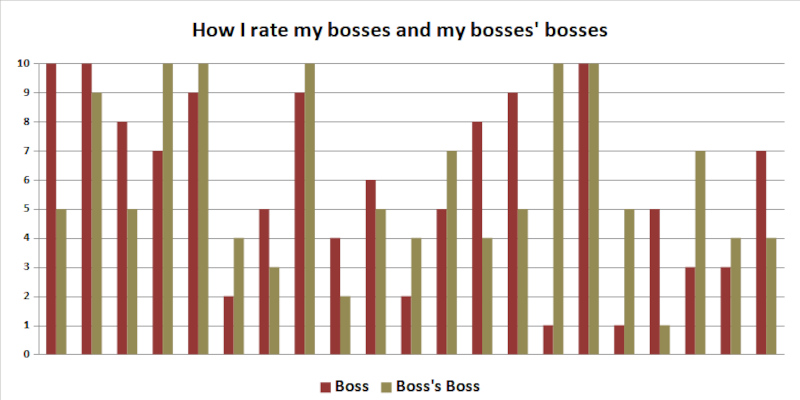
Note: A lot of the people I’ve worked with read my posts so I’ve scrambled the order of the rankings so no one can be identified.
I’ll be the first to admit that going through this exercise is a far stretch from being scientific… I just ranked by bosses (let’s call this group B1) and my boss’s bosses (B2) based on my assessment of how good they were. Some failed miserably and some excelled.
A couple interesting observations. First. it seems that B1’s are more likely to rank highly if B2 also ranks highly. Not all the time — in fact one of the worst B1s had a B2 that rated #10 — but most of the time. The same is not true for low ranking B2s though. It seems that B1s can be ranked highly regardless of the skill of B2. (Sorry if all these “B”s are feeling a little distracting)
What that seems to point to is that highly skilled leaders (B2) have a tendency to breed other highly skilled one level down leaders. Also, managers have the ability to rise above the incompetence of their bosses.
Here’s something else that came out of this. If I group the low performers and try and pinpoint why I rated them lowly, here are some of the general characteristics I come up with.
Low Ranked Bosses or Bosses’ Bosses
• Secretive
• Dictatorial
• Micro managers
• Order Takers
• Turf focused
• Blamer
• CYA mentality
• Untrustworthy
• Scared
Once again, this isn’t scientific, it’s just what my personal impressions are about this group.
When I look at the high ranking leaders, those I ranked 9 or 10, I come up with this list:
• Fair
• Knowledgeable
• Trusting
• Risk Taker
• Appreciative
• Capable
• Fun
• Negotiator
• Confident
• Patient
• Problem Solver
What I get from that is that it’s not so much what the Bad leaders DO that make them bad leaders, it’s often what they don’t do. They don’t trust, they don’t seek input, they don’t take risks, they don’t challenge authority.
It also seems clear to me that most of the skills in the highly ranked leaders are learnable.
That leaves one final question. If it is true that leaders can become great without reporting to a similar great boss and, if the skills of a great leader are learnable, then why aren’t there more great leaders? The answer seems obvious. They’ve never been shown how.
The Center for Creative Leadership lists the following qualities for a great leader.
• Self-Awareness
• Respect
• Compassion
• Vision
• Communication
• Learning Agility
• Collaboration
• Influence
• Integrity
• Courage
• Gratitude
• Resilience
If you are a good leader, thriving to become a great one, take an honest introspective look at this list, or the earlier one on top-ranked leaders in my life. Promote your strengths and work on developing where you have room to grow.